There is a peculiar difficulty in naming a business after yourself. At the beginning it feels entirely natural — the work is yours, the reputation is yours and, particularly in a creative profession, there is something reassuringly straightforward about simply putting your name above the door. The difficulty comes much later, when the name remains largely unchanged while the person, the work and perhaps even the ambition behind it have moved somewhere else entirely.
I filmed my first wedding in 2007 in Sienna in Italy, for our friends, Claire & Johnathan, and, over the years that followed, Mike Flannery Wedding Films became an established name, one that was familiar to couples and to the photographers, venues and other wedding professionals I worked alongside. People like to know who they are dealing with, and it was reassuring to other vendors that it was me behind the camera. There was no particular moment when it suddenly became the wrong name, nor was there anything fundamentally wrong with it; it simply began to feel increasingly descriptive of the person behind the camera, rather than representative of the work being created.
And the work had changed enormously.
In truth, almost everything had.
Looking beyond home
Some of the most significant influences on that change came from looking beyond the Irish wedding industry and, in particular, towards the extraordinary work being produced by a number of Asian wedding filmmakers.
Filmmakers such as Jason Magbanua in the Philippines, and companies including Studio King, approached weddings with an ambition and visual confidence that I found fascinating. Their films placed an enormous emphasis on cinematography and composition, creating images with layers and depth, contrasting elements within the frame, beautiful colour and soft, diffused light. They were unmistakably wedding films, but they also borrowed from the visual language of cinema, fashion and commercial filmmaking.
That distinction interested me.
Music has always been central to the way I edit. I have a very musical ear and tend to instinctively recognise rhythm, changes in pace and those small moments within a piece of music where an image seems naturally to belong. Seeing filmmakers use music, cinematography and movement together in increasingly sophisticated ways encouraged me to become much more deliberate about what was happening within each individual shot, rather than thinking only about how a collection of shots would eventually fit together in the edit.
It also reinforced an interest I already had in the smallest details of a wedding day.
A macro lens can transform something as familiar as a wedding ring into an almost abstract landscape, revealing texture, reflections and imperfections that are invisible to the naked eye. There is something appealing about briefly entering that microscopic world, not simply because the details are beautiful, but because so much of the meaning of a wedding is contained within seemingly insignificant things — a ring, a handwritten note, a hand resting on somebody’s shoulder, the movement of fabric or a nervous adjustment of a button.
The same is also true of movement.
I’ve always been drawn to shots of people walking: feet crossing a floor, a bridal party moving between rooms, a couple disappearing into a landscape or a group travelling from one part of the day to another. On the surface these are useful transitional shots, but there is also something quietly appropriate about them. A wedding is a day defined by movement — through rooms, buildings and landscapes, certainly, but also from one stage of life into another.
The physical journey and the metaphorical one occasionally become the same thing… A Bride or Groom walking into a ceremony venue at the beginning of the ceremony is both physically entering a room, but also symbolically entering a new stage in life.
That growing interest in visual storytelling gradually made the old identity feel less representative of what the films were becoming, and for several years the idea of finding another name remained somewhere in the background.
Finding Monocle
The name, when it eventually arrived, came remarkably close to home.
My wife Monica suggested Monocle, a phonetic blending of Monica and Michael which immediately felt as though it had possibilities. Naturally, rather than accepting a good idea when it presented itself, I then spent a considerable amount of time trying to improve it.
There was “White Monocle”, “Green Monocle”, “Monocle and Veil” and a collection of other variations which are probably best left wherever abandoned business names go to die.
None quite worked.
It was Monica, again, who eventually suggested adding two very simple words: & Co.
For whatever reason, that was the moment the name stopped sounding like an idea and began to sound like a business.
The timing also made sense. The business had become incorporated as a limited company in 2024, but the meaning of the “& Co.” gradually became broader than the corporate structure behind it. Although much of the filmmaking itself remains the work of one person, weddings have never really been solitary creative endeavours.
Monica is part of the company and part of its story, but the wider “company” can also be understood as the people who repeatedly come together to create these days: associate filmmakers, photographers, musicians, celebrants, planners, venue teams and the many familiar faces encountered weekend after weekend. After almost two decades and hundreds of weddings, many of those professional relationships have developed into genuine friendships, and I count many photographers in particular as close friends that goes beyond the work.
A wedding may have one couple at its centre, but creating the day — and documenting it well — has always been a collective effort.
In that sense, Monocle & Co. felt considerably more truthful than a name which placed one person at the centre of everything.
From Deco to Monocle
Finding the name was only the beginning. Finding a visual identity to accompany it proved considerably more difficult.
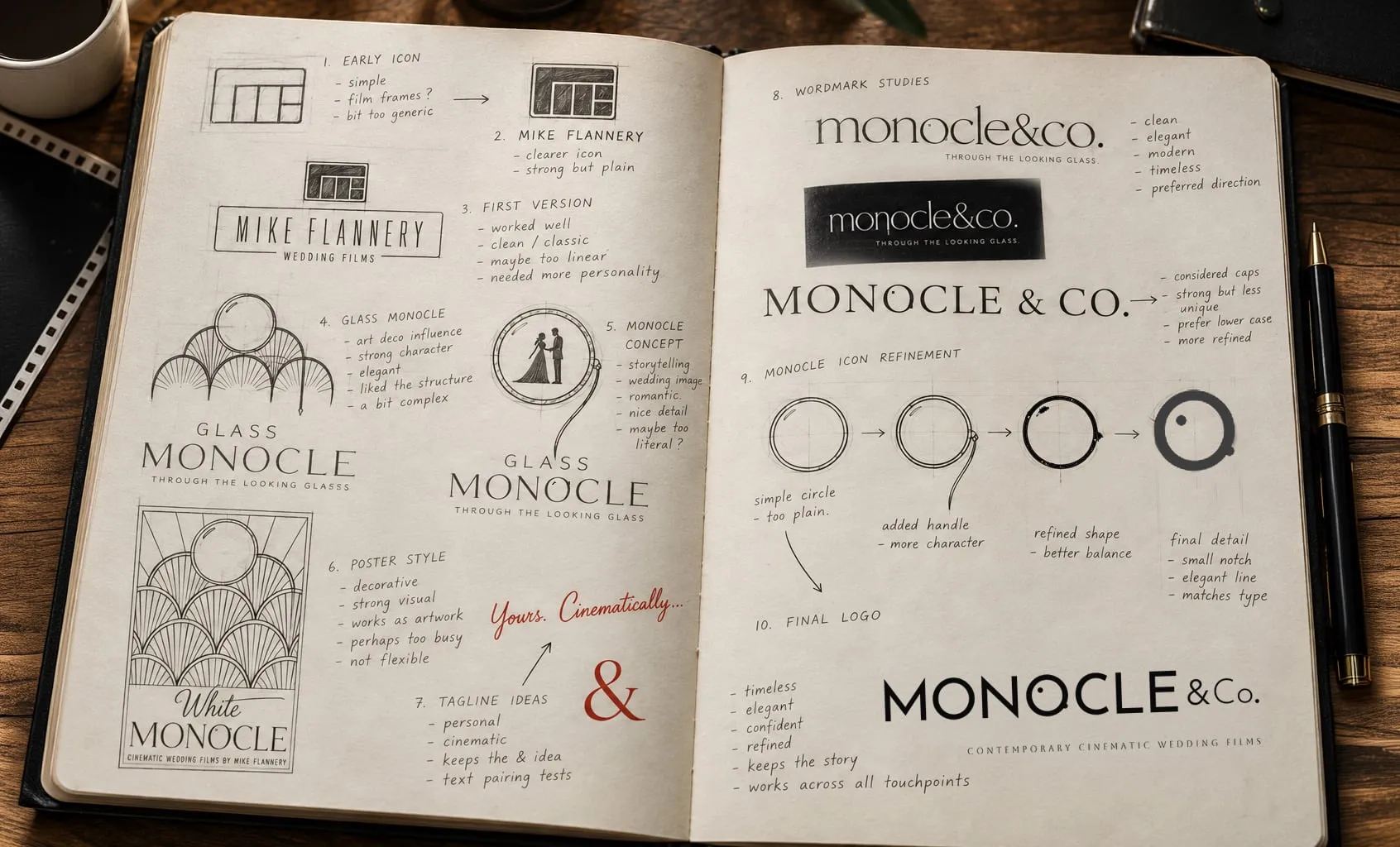
The monocle itself inevitably carries associations with a particular period, and many of the earliest attempts at the identity leaned heavily into Art Deco: geometric forms, period typography and the unmistakable visual language of the 1920s and 30s.
They were attractive, but they weren’t right.
The films themselves aren’t traditional or nostalgic, and an identity which looked backwards too deliberately created the wrong expectation. What gradually emerged instead was something closer to a neo-deco approach — retaining some of the geometry, balance and restraint of Deco, but stripping away the ornamentation and interpreting it through a much more contemporary visual language.
After numerous iterations, the current identity began to take shape: clean sans-serif typography, the monocle incorporated into the central letterform and an almost entirely monochrome palette.
There is a pleasing symmetry to that monochrome identity which wasn’t necessarily engineered from the outset. Mono already sits within the name Monocle, while black and white have their own obvious relationship with weddings: the traditional contrast between bride and groom, light and dark, black on white and white on black.
Sometimes an identity becomes more convincing not because every element was strategically planned, but because the pieces begin to make sense together.
The evolution of the film
A change of name would be fairly meaningless if the work behind it had remained static.
Compare a wedding I filmed ten years ago with one filmed today and the differences extend far beyond image resolution or the equipment being used. The cameras have changed, certainly, but so too have the methodology, editing, camera movement, shot duration, composition, treatment of light and shadow, interaction with couples and the amount of thought given to what exists in front of, behind and around the principal subject.
Modern cameras allow all of the current films to be captured in 10-bit, 4K S-Log footage, retaining a far greater range of information in highlights, shadows and colour than was previously possible. Multiple cameras provide different perspectives on the same moment, while diffusion filters — even on the drone — soften some of the clinical sharpness associated with modern digital sensors and help create a gentler, more cinematic image.
But technical specifications are useful only insofar as they serve the image.
There is now considerably more attention paid to the quality and direction of light, to reflections and foreground elements, to the separation between a person and their surroundings, and even to the atmosphere in the air itself. Additional lighting might be introduced not because a room is too dark, but because a subtle rim of light can separate a person from the background; occasionally haze or atmospheric spray can make an existing shaft of sunlight visible, giving physical form to light that was already present.
Paradoxically, as the technology and methodology have become more sophisticated, there has also been a greater willingness to do less.
There is more stillness now, allowing a shot to develop and move within the frame rather than assuming that the camera itself always needs to provide the movement. Shots are allowed to breathe for longer. Composition is more deliberate. The temptation to collect footage simply because something is happening has increasingly been replaced by the question of how that moment might best be observed.
Wedding filmmaking generally has travelled in a similar direction. The best contemporary films feel more thoughtful and purposeful, but purposeful filmmaking does not necessarily mean manufacturing what happens in front of the lens.
Quite often, it means recognising something before it happens and being in the right place when it does.
The people within the frame
For all the attention given to cinematography, a wedding is firstly and lastly a real event — a significant day in the lives of two people and their families — and that reality should never become secondary to the desire to make beautiful pictures.
One of the less tangible benefits of filming hundreds of weddings since 2007 is learning to read people quickly.
Some people are completely at ease with a camera. They enjoy interacting with it, are happy to experiment and will enthusiastically participate in something more deliberately constructed. When that personality is there, it opens the door to playful, creative and sometimes quite unusual imagery.
Others would be perfectly content never to see a camera at all.
Irish couples, in particular, can often be wonderfully understated. They may have absolutely no desire to perform, pose or recreate somebody else’s wedding reel for the sake of a shot, and asking them to do so rarely produces anything that feels honest.
The approach therefore has to change with the people.
A longer lens creates physical distance and allows conversations and interactions to unfold naturally. At other times, a little direction provides enough structure without making the moment feel staged. Humour helps enormously too; after meeting thousands of people at weddings over the years, the ability to make somebody laugh — or occasionally deploy a truly dreadful pun at precisely the right moment — can be every bit as useful as knowing which lens to choose.
There isn’t one correct way to film people because people aren’t all the same.
The aim is simply to meet people where they’re at, understand their level of comfort and work from there.
That flexibility matters because the wedding itself is more important than the wedding film. The film should emerge from the personalities and atmosphere of the day, rather than the day being repeatedly interrupted to satisfy a predetermined formula for the film.
Polished, imperfect and real
Perhaps one of the more interesting changes in recent years has been a growing appreciation for the parts that aren’t polished at all.
Far more footage is captured during a wedding than will ever be required for the principal films, and alongside the finished edits there is something wonderful about preserving longer sections of that material with their original sound and timing intact.
Those sequences have a completely different quality. Conversations don’t end neatly on an edit. Someone wanders through the background. There are pauses, interruptions and pieces of dialogue that would never survive the discipline of a short cinematic film.
Yet viewed years later, those imperfections may be precisely what gives the footage its value.
A carefully edited wedding film captures the story and feeling of a day, but longer, less polished footage can do something slightly different: it can allow someone to briefly inhabit it again.
The two ideas aren’t in conflict.
There is room for craft and spontaneity, for carefully composed cinematography and shaky handheld footage, for perfect light and happy accidents, for the polished film and the moments around its edges.
Increasingly, that contrast is where the interesting work seems to happen.
A new chapter, rather than a new beginning
Monocle & Co. isn’t an attempt to draw a line through what came before it, and it certainly isn’t a new filmmaker appearing fully formed behind a new logo.
It is the opposite.
The identity has grown out of almost two decades spent filming weddings, experimenting, making mistakes, following changing technologies, absorbing influences from filmmakers around the world and, perhaps most importantly, learning from the people encountered along the way.
The ambition now is not to create wedding films according to a single recognisable formula, but to bring the same level of care and craftsmanship to films which can still feel distinctly different from one another.
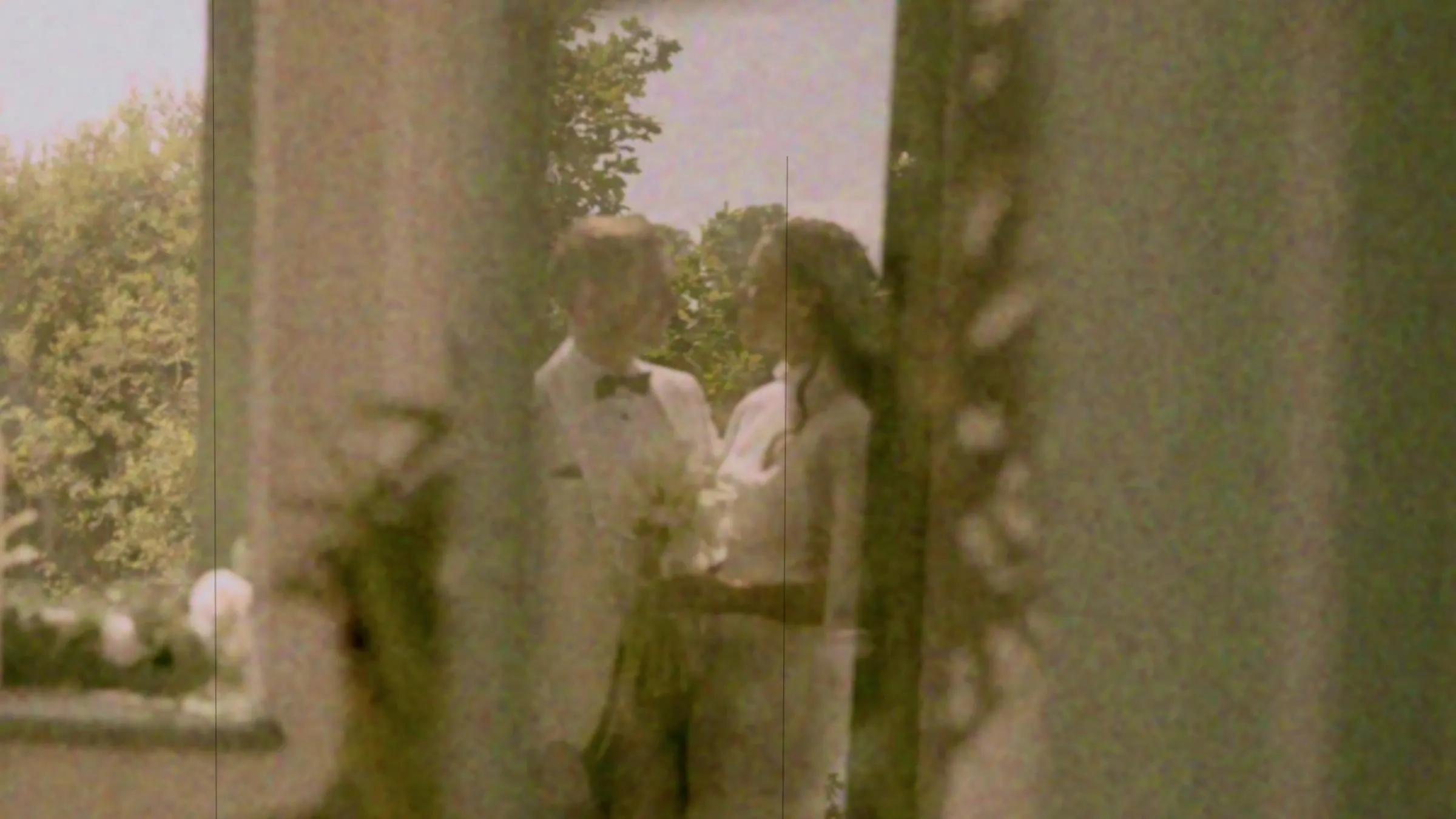
One wedding might call for stillness and restraint; another might be energetic, playful and full of movement. There can be cinematic compositions alongside imperfect handheld moments, contemporary digital imagery alongside the texture and nostalgia of Super 8-inspired footage. The consistency shouldn’t necessarily come from making every film look the same, but from the thought, attention and care that goes into making each one.
Because ultimately the details matter.
The light matters. The composition matters. The music, sound, colour and pacing matter. The almost invisible decision to move a camera six inches to one side because the frame suddenly feels better matters.
But none of those things matter more than the people.
Perhaps that is the clearest expression of what Monocle & Co. has become: an attempt to make films with genuine craftsmanship and attention to detail, without losing the humour, honesty, interaction and occasional imperfection that make a wedding feel human.
To know when to shape something and when to observe it; when to move closer and when to disappear; when to create an image and when to recognise that the better one is already happening.
The name may be new, but it is built on a foundation of experience and skill, decades in the making.